
Gaia Webinar: Indonesia Geothermal Resources & Economic Opportunities

- This event has passed.
https://connect.spe.org/sdts/home
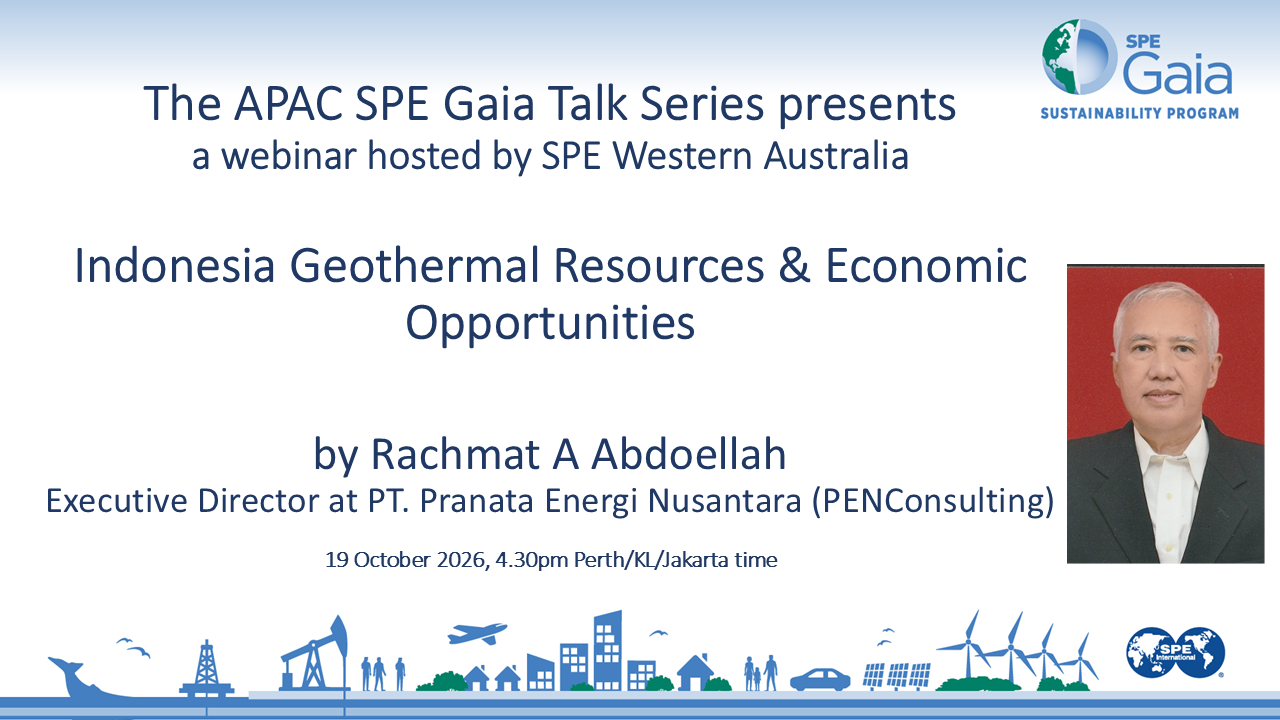
A free webinar hosted by SPE Western Australia.
The Speaker
Rachmat A Abdoellah has 32 + years’ experience in energy company and worked for Chevron IndoAsia Business Unit as Vice President of Planning and Technology in early 2000 during that time Chevron was the largest operator of Geothermal Operations in Indonesia and Philippines and produced 20% of energy needs in Indonesia from Oil and Gas and Geothermal. Rachmat transitioned to lead PT Pranata Energi Nusantara (PENConsulting), an Indonesian process consultant, as Executive Director and as of June 2026 as President Director and continues to advice and support energy projects through strategic consulting services.
His Talk
Global Capacity Baseline: Global installed geothermal capacity stands at 17.2 GW across 35 nations, supplying continuous 24/7 carbon-free baseload energy with capacity factors exceeding 80–90%. Supply is heavily concentrated, with the top 10 nations holding over 93% of capacity—led by the United States (~3,950 MW) and Indonesia (2,740 MW).
Indonesia’s Strategic Reserve: Tectonically positioned along the Pacific Ring of Fire, Indonesia holds an estimated 24 to 28 GW of geothermal potential (~40% of the world’s total reserves). With only ~10–11% tapped to date, the archipelago offers massive headroom for institutional, foreign, and private capital.
Regional Resource Distribution: Reserves are structured across three volcanic belts:
• Sumatra Corridor (~9.6 GW): Largest concentration of untapped high-enthalpy greenfield reserves.
• Java & Bali Corridor (~9.3 GW): Located directly adjacent to high-density industrial load centers.
• Eastern Island Arcs (~5.1 GW): Critical for displacing island diesel generation and powering regional mineral processing.Market Ownership Structure: State-Owned Enterprises (SOEs) anchor the market under Geothermal Working Areas (Wilayah Kerja Panas Bumi / WKP). PT Pertamina Geothermal Energy Tbk (PGE) controls ~80%+ of domestic operations (~727 MW direct, ~1,205 MW via Joint Operation Contracts). PT PLN (Persero) serves as the national power off-taker while developing regional island WKPs.
Acreage Acquisition Pathways: Managed via ESDM’s digital GENESIS portal, acreage is allocated through three regulatory routes: Public WKP Auctions for surveyed blocks; PSPE Assignments (private early exploration earning a Right of First Refusal); and SOE Direct Assignments for national strategic assets.
Upstream Financial De-Risking: Exploratory test wells cost $6M to $8M each with ~50% dry-hole risk. Indonesia mitigates this via the Geothermal Resource Risk Mitigation (GREM) facility ($650M+ World Bank/PT SMI platform converting failed wells into non-repayable grants), government-drilled blocks, and 100% tax/duty exemptions.
Next-Gen Value Expansion: To increase project returns beyond traditional state power purchase agreements (8–12% IRR), developers are building integrated Multi-Product Energy Hubs (targeting 14–20%+ IRR). Key revenue drivers include Green Hydrogen and Ammonia co-generation, Direct Lithium Extraction (DLE) from hot brine, direct thermal heat utilization, and carbon offset monetization.