
SPE QLD online event – Free for members – Advanced Rate-Transient Analysis for Unconventional Reservoirs: Bridging Theory and Field Applications

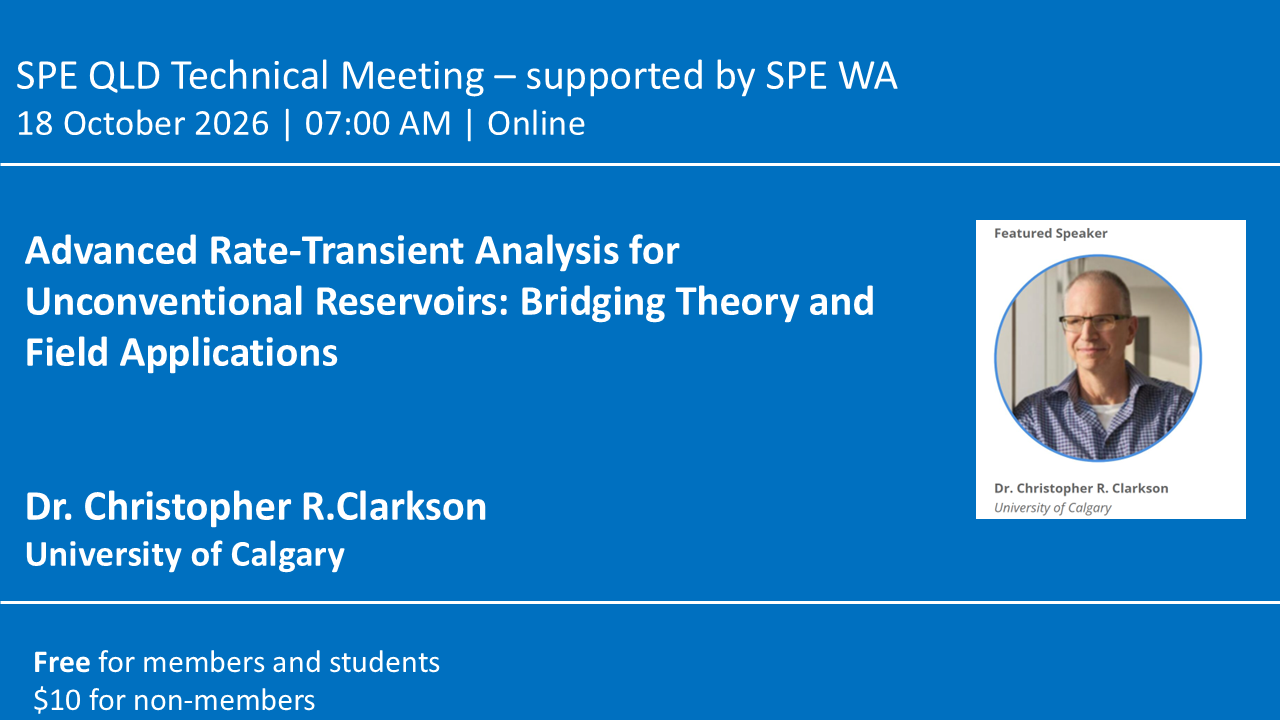
SPE WA is pleased to share an upcoming online event hosted by SPE Queensland with our members in Western Australia and Timor-Leste. The event is free for SPE members and students, with a $10 registration fee for non-members.
Event details are provided below.
Abstract
The rapid development of unconventional reservoirs (tight gas/oil, shale gas/oil, and coal seam gas) has challenged conventional reservoir engineering workflows and created a need for advanced production analysis techniques. Rate-Transient Analysis (RTA) has emerged as one of the most powerful tools for reservoir characterization, hydraulic fracture evaluation, fluid-in-place estimation and production forecasting in low-permeability reservoirs.
This presentation will provide an overview of the latest developments in unconventional reservoir RTA and demonstrate how modern analytical methods can be applied to extract valuable reservoir and completion information directly from production data. Some fundamentals of RTA are first provided, followed by review of a comprehensive workflow for quantitative RTA that advances from flow-regime identification to straight-line and type-curve analysis to model history matching. Application of this workflow will be demonstrated with a Beetaloo Basin shale well.
Advances of RTA to account for unconventional reservoir properties such as multiphase flow, fracture complexity, and inter-well communication will be reviewed. Modern RTA approaches, including RTA-assisted numerical model history matching, will also be discussed. These advances will be demonstrated using field examples from North American shale and tight reservoirs, which will illustrate how hydraulic fracture complexity, reservoir heterogeneity, multiphase flow, and inter-well communication impact production performance and interpretation of diagnostic plots.
Finally, application of RTA methods to tight core analysis for estimating permeability and porosity will be showcased. This approach which helps to bridge the gap between lab and field data.
The session will conclude with a review of best practices, common interpretation pitfalls, and future directions for production data analytics in unconventional resource plays.
Key Learning Objectives
- Understand the fundamental principles of Rate-Transient Analysis in unconventional reservoirs.
- Identify diagnostic flow regimes and their significance for reservoir characterisation.
- Apply RTA techniques to estimate reservoir and hydraulic fracture properties and fluid-in-place.
- Recognise challenges associated with multiphase flow, complex fracture networks, and inter-well communication.
- Learn practical workflows and best practices for field implementation.
Target Audience
Reservoir Engineers, Production Engineers, Petroleum Engineers, Geoscientists, Asset Managers, and professionals involved in unconventional resource development and production optimisation.
Featured speaker Dr Christopher R. Clarkson
Christopher R. Clarkson is the Tamaratt Research Professor in Transitional Energy, and the Ovintiv/Shell Chair in Unconventional Gas and Light Oil research, in the Department of Earth, Energy, and Environment (formerly Geoscience), and an adjunct professor with the Department of Chemical and Petroleum Engineering, at the University of Calgary. He is internationally recognised as one of the foremost experts in unconventional reservoir engineering, with more than two decades of experience in reservoir characterisation, production data analysis, and the development of advanced analytical methods for shale gas, tight gas, tight oil, and coalseam gas reservoirs.
Professor Clarkson has made significant contributions to the advancement of Rate-Transient Analysis (RTA), production diagnostics, hydraulic fracture evaluation, and unconventional reservoir characterisation. His research has helped establish many of the methodologies widely used today for estimating reservoir properties, evaluating stimulation effectiveness, forecasting production performance, and understanding flow mechanisms in low-permeability reservoirs.
He has authored and co-authored hundreds of technical publications, including numerous SPE papers, peer-reviewed journal articles, book chapters, and the highly acclaimed reference book Unconventional Reservoir Rate-Transient Analysis. His work has been extensively cited by both industry professionals and academic researchers worldwide.
Throughout his career, Professor Clarkson has collaborated closely with leading operators, service companies, and research organisations, bridging the gap between academic innovation and practical field application. He has been an SPE distinguished lecturer, keynote speaker, and instructor for industry training courses focused on unconventional resource development and reservoir engineering best practices.
Professor Clarkson’s ongoing research continues to advance the understanding of unconventional reservoir behaviour, integrating geological, petrophysical, geomechanical, and production data to improve reservoir management and optimise field development strategies.
RSVP by 16 November – By clicking on the SPE QLD website link under details below.